
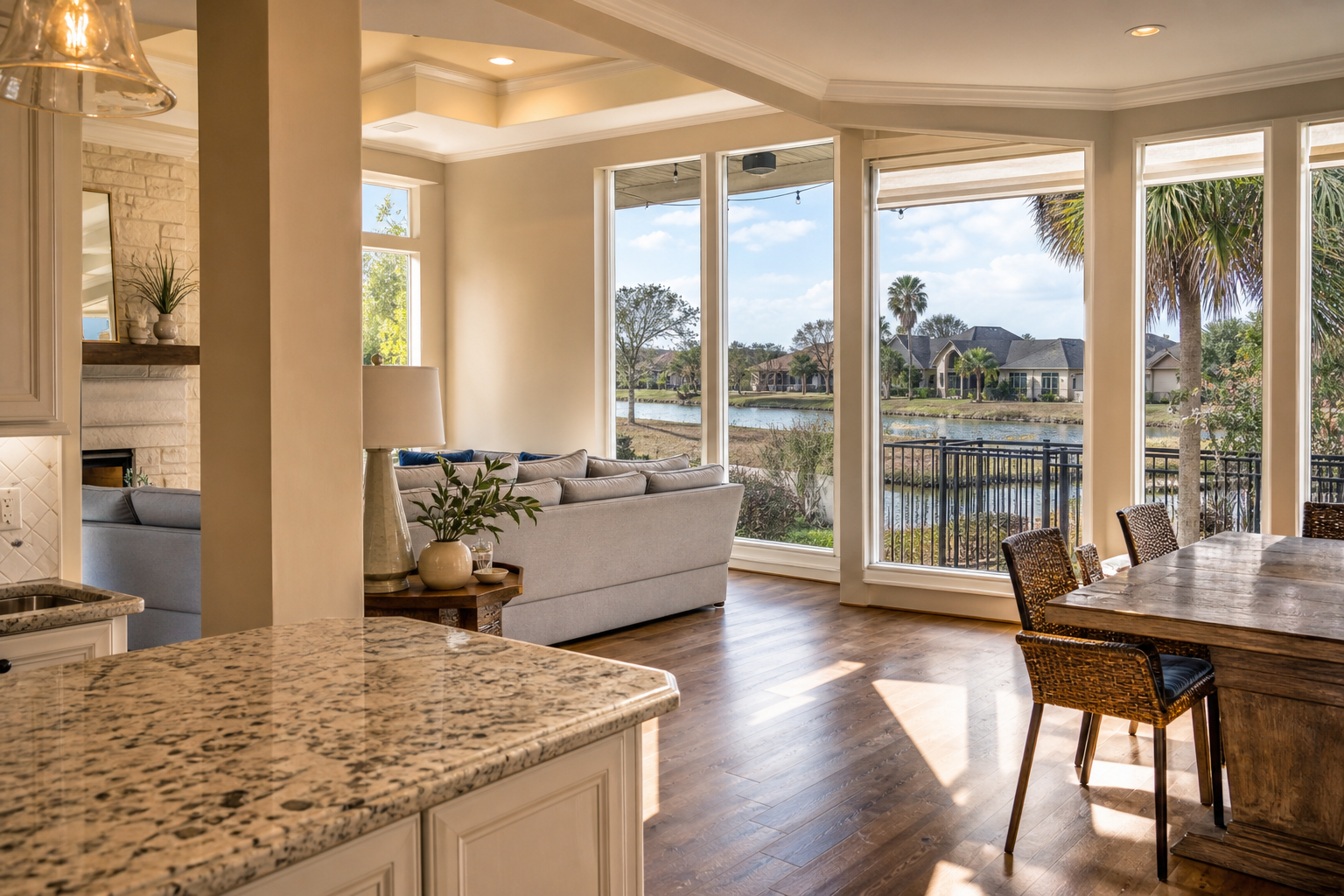
Look up the property on FEMA’s current effective flood map, confirm the result with the City of League City, and get an insurance quote early. A map zone is not a flood forecast, so also request elevation and permit records and inspect drainage and the lot before your option period ends.
Before Buying in League City, Check the Flood Zone
How do you check flood risk before buying in League City?
Before buying in League City, look up the exact address on FEMA’s current effective flood map, then confirm it with the City of League City’s floodplain information. Treat the zone as a starting point, not a forecast, because homes outside the mapped floodplain can still take on water. Get an insurance quote early, request elevation and permit records, and inspect the drainage around the lot before your option period ends.
Key Takeaways
- League City reports that its revised FEMA flood map, effective August 15, 2026, places about 10,674 acres and 3,730 homes in the Special Flood Hazard Area.
- About 7,378 more homes fall in the 0.2% annual-chance area, so a home outside the 100-year floodplain is not automatically low risk.
- A federally regulated lender generally must require flood insurance when the building securing the loan is in a Special Flood Hazard Area, and a lender can require it elsewhere too.
- An elevation certificate is not required to buy flood insurance, but it gives your insurance agent precise elevation data to work with.
- For residential construction permitted on or after October 1, 2018, League City requires the lowest floor to be at least 24 inches above the applicable reference elevation.
How do you verify a property’s flood zone before buying in League City?
Pull the property’s address into FEMA’s Flood Map Service Center, read the current effective map panel, and write down the zone. Then check the same address against the City of League City’s floodplain pages. Two sources beat one.
Start with the current FEMA map
Use the FEMA Flood Map Service Center and look at the current effective Flood Insurance Rate Map. Don’t rely on an old listing sheet, an older appraisal, or a prior owner’s word. Those can reflect a map that has since changed.
Note whether the building itself, not just a corner of the lot, sits in the Special Flood Hazard Area. That distinction matters for lending. Your lender’s flood determination can also differ from what you read off the map by eye.
Confirm it with the City of League City
League City reports that a revised FEMA map became effective August 15, 2026. According to the city’s floodplain and stormwater page, the revision puts roughly 10,674 acres and 3,730 homes in the Special Flood Hazard Area, commonly called the 100-year floodplain. It also identifies about 6,420 acres and 7,378 homes in the 0.2% annual-chance area, formerly called the 500-year floodplain.
If you looked at a property before this revision, look again. The map you saw may no longer be the one that applies.
Know what each layer means for you
| Map layer | What it means | What to do next |
|---|---|---|
| Special Flood Hazard Area (100-year floodplain) | Higher-risk area where a federally regulated lender generally must require flood insurance for the building | Get an insurance quote before you finish inspections |
| 0.2% annual-chance area (formerly 500-year) | Lower-risk mapped area that still carries real flood exposure | Ask about elevation, drainage, and insurance, since a lender may still require coverage |
| Outside both mapped areas | Not a guarantee against localized or stormwater flooding | Investigate the lot, the street, and nearby drainage |
Why isn’t the FEMA zone enough, and what else should you investigate?
A FEMA zone tells you the mapped flood category, not whether a specific house has flooded or will flood. FEMA’s own guidance recognizes that localized flooding can occur outside the Special Flood Hazard Area, so you need to look at drainage, nearby channels, and the property’s history.
Where does water move around League City?
The City of League City says its flood-prone areas primarily follow Clear Creek, Galveston Bay, Benson Bayou, Geisler Bayou, and Dickinson Bayou. The city also has numerous secondary watersheds and drainage features across roughly 55 square miles.
Whether you’re looking at a bayside street near South Shore Harbor or an inland subdivision, ask the same questions:
- Where are the nearest detention ponds, outfalls, and drainage easements?
- Where does water go downstream of this street?
- Does the street or yard hold water after heavy rain?
A favorable map letter doesn’t answer those questions. A walk of the neighborhood does.
What should you inspect on the lot before the option period ends?
Look at the ground, not just the rooms. Your option period is the window in your contract to inspect and then negotiate or walk away, and the length is set in your own contract, so confirm it right away.
Here’s what I’d have you look for:
- Low points, swales, and ponding near the foundation
- Blocked or undersized drainage structures
- Water marks, eroded soil, or staining on walls and in garages
- A driveway that slopes toward the house
- HVAC equipment and utilities sitting low on the property
If you can, visit after a rainfall. Then talk to neighbors about street, yard, and garage flooding. Their answers are often more useful than any report.
If the lot looks low or flat, bring that concern to your inspector and ask for a closer look at drainage and grading. For waterfront and near-water purchases, my walkthrough on buying waterfront property in League City covers more of the process.
What should you ask the seller and your insurance agent?
Ask the seller for every document that shows how the home has handled water, and ask an insurance agent for a real quote before you commit. Do both while your option period is still running, so you still have room to negotiate or walk away.
Which documents should you request from the seller?
- Any existing elevation certificate
- Prior flood-insurance declarations or claims information the seller is willing and legally able to share
- Permits for additions, conversions, raised utilities, or substantial improvements
- Drainage or foundation reports
- Records of prior water intrusion
An elevation certificate is useful evidence. FEMA explains that it is not required to buy flood insurance, but it provides more precise information about the structure’s lowest-floor and site elevations and can help an insurer evaluate the premium. It also doesn’t remove a mandatory-purchase requirement, and it is not a guarantee the home won’t flood.
When should you get a flood insurance quote?
Get it early, before inspections wrap up. A quote can change how you view the purchase, and it’s much better to learn that while you still have options.
Ask your agent to quote both building and contents coverage, and to explain:
- Exclusions and deductibles
- How replacement cost is treated
- Any waiting periods
- Whether an existing policy can be assumed or transferred
According to FEMA, the mandatory federal requirement is tied principally to the building securing a federally related loan in a Special Flood Hazard Area. Lenders can also require coverage when federal law does not. Your lender will tell you what applies to your loan.
What about newer homes and recent additions?
If the home is newer or has been substantially improved, compare it with the city’s elevation rules. For residential construction or substantial improvement permitted on or after October 1, 2018, League City’s development requirements call for the lowest floor, including a basement, to be at least 24 inches above the larger of the base flood elevation, the crown of the nearest street, or the highest adjacent grade. The structure must also be at least 3 inches above the nearest 500-year flood elevation.
The city also states that an elevation certificate has been required before the concrete form is poured for development in its shaded X zone since October 1, 2018. Ask for the certified elevation documentation from the permitting records.
Does a map change mean the risk is gone?
No. Elevation information can support a request for a Letter of Map Amendment or Letter of Map Revision based on fill, but FEMA’s guidance says map status and insurance requirements still have to be confirmed through FEMA and the lender. A home can remain vulnerable to stormwater flooding even when its mapped designation changes.
Every property is different, and your answer depends on the address, the lender, and the home’s history. That’s exactly what I walk my clients through before they write an offer. If you’re comparing areas first, my League City buyer checklist is a good starting point.
You can read what past clients say about working with me on Google, Zillow, and Realtor.com.
FAQ
How do I check whether a League City property is in a FEMA flood zone?
Enter the property address in the FEMA Flood Map Service Center and read the current effective Flood Insurance Rate Map. Confirm the result with the City of League City’s floodplain information, and note whether the building itself is in the Special Flood Hazard Area. Your lender’s determination is the one that drives insurance requirements.
Is a house in Zone X in League City safe from flooding?
No, a Zone X designation does not make a house safe from flooding. FEMA notes that lenders may require insurance outside the federal mandatory-purchase area, and localized flooding can happen outside the mapped floodplain. Check drainage, nearby channels, street flooding, and any history of water intrusion.
Does my lender require flood insurance if the property is outside the 100-year floodplain?
Not always, but it can. Federal law generally requires coverage when the building securing a federally regulated loan is in a Special Flood Hazard Area. A lender may still require it for properties outside that area, so ask your lender early and get an insurance quote before your option period ends.
How can I find out whether a League City house flooded before?
Ask the seller directly and request any records of prior water intrusion, repair permits, and insurance claims information the seller is willing and legally able to share. Look for water marks and staining during your inspection, and talk with neighbors about street, yard, and garage flooding.
Should I ask the seller for an elevation certificate before buying?
Yes, ask whether one exists. It gives your insurance agent more precise elevation information and can help with the premium evaluation. It is not required to buy flood insurance, and it does not guarantee the home won’t flood, so use it alongside your drainage inspection.
Before buying in League City, the goal is simple: know the mapped zone, know the real drainage picture, and know your insurance answer while you still have time to act. I help my buyers pull those pieces together before the option period closes the door. Call me at 281-900-9663 or search homes in League City to get started.
Equal Housing Opportunity. Lisa Marie Sanders, TX Broker, regulated by the Texas Real Estate Commission (TREC). Review the TREC Information About Brokerage Services and Consumer Protection Notice. This article is general information, not legal, tax, or financial advice. Confirm your own numbers and requirements with your title company, tax advisor, insurance agent, or lender.